
NVIDIA Announces New AI Agent Tools, Nemotron for Science, Rubin HPC GPU, and Expanded Vera CPU Platform at SC26
2 min read
- NVIDIA
- AI agents
- HPC
- scientific computing
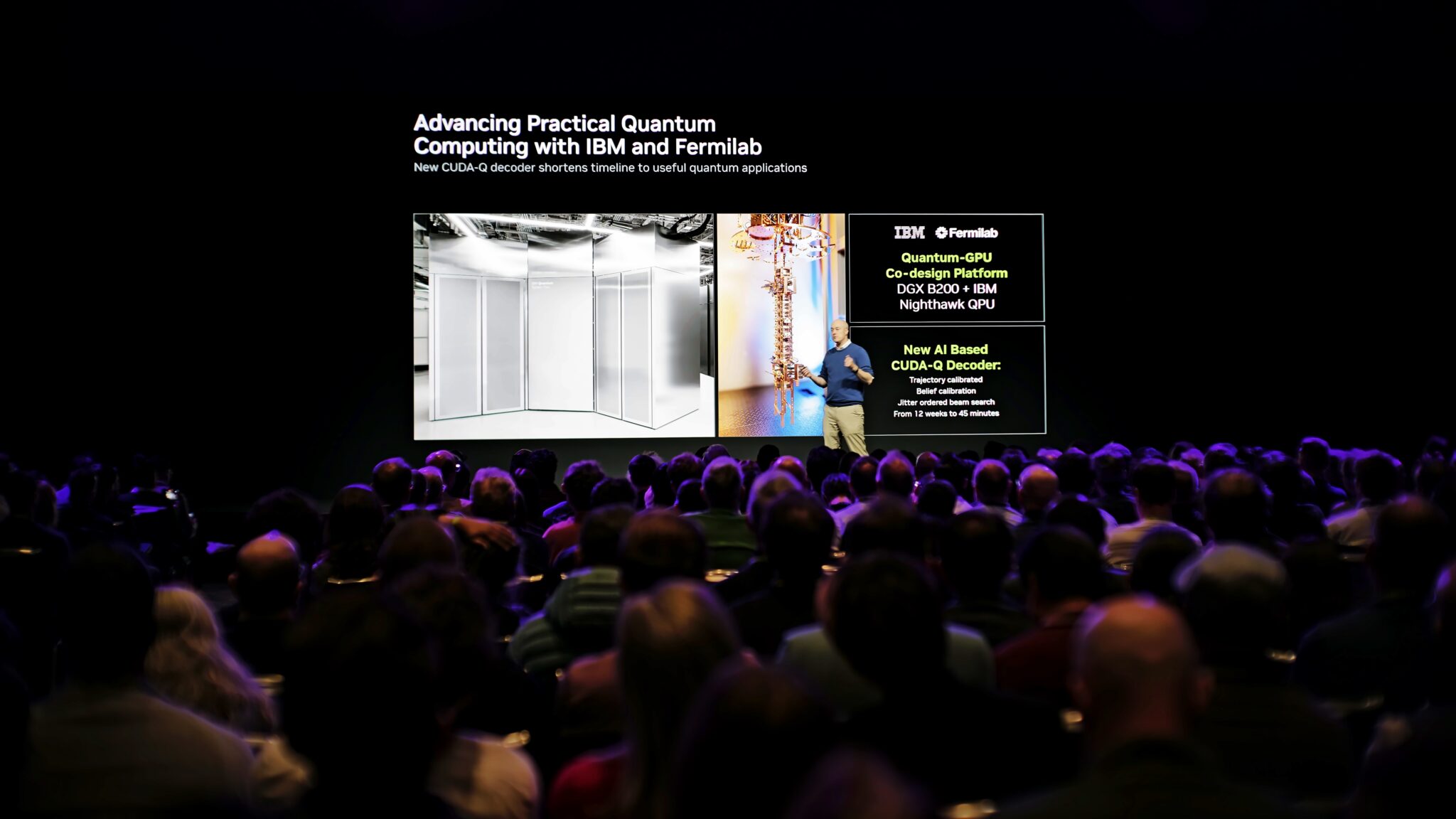
NVIDIA’s vice‑president of hyperscale and high‑performance computing, Ian Buck, opened the company’s week at SC26 in Chicago with a series of announcements aimed at accelerating scientific discovery. The new offerings include tools for AI agents that can plan experiments, run code, and verify results on researchers’ own systems, a specialized AI model called Nemotron for Science, the Rubin HPC GPU, and an expanded Vera CPU platform for high‑performance computing. Buck also highlighted a new quantum‑computing collaboration with IBM and Fermi National Accelerator Laboratory.
What’s new
- AI agent toolkit – Software that lets agents plan experiments, execute code, and check outcomes on local workstations, DGX Spark systems, or existing supercomputers.
- Nemotron for Science – An open‑model based on the Nemotron 3.5 Super VL architecture, paired with an open chemistry dataset and post‑training recipes for life‑science and chemistry workloads. It can run locally on DGX Spark, workstations, or any compatible supercomputer.
- Rubin HPC GPU – A new GPU in the Vera Rubin platform designed for scientific, engineering, analytics, and AI tasks. It supports precision modes from FP64 to FP4, adds sparse‑data acceleration, and connects via seventh‑generation NVIDIA NVLink. With more than 50 000 CUDA cores, it offers roughly three times the core count of the Hopper generation.
- Expanded Vera CPU platform – Additional Vera CPUs have been selected for the German Climate Computing Center’s HLRE‑5 supercomputer (expected early 2028) and join earlier Vera deployments at the Texas Advanced Computing Center. These CPUs are optimized for the “agent loop,” handling tool calls and evaluation between model steps.
- Quantum collaboration – NVIDIA announced a partnership with IBM and Fermi National Accelerator Laboratory to explore quantum‑computing applications alongside AI and simulation.
Why it matters
The announcements signal a shift toward integrating AI agents directly into scientific workflows. By enabling agents to autonomously design and test hypotheses, researchers can reduce the manual effort required for complex simulations. Buck cited an example from Argonne National Laboratory where an agent, using the new toolkit, took a single prompt, planned experiments, ran simulations, and identified two new binding sites—demonstrating the potential for rapid discovery.
Existing agent deployments illustrate practical benefits: an agent from KTH Royal Institute of Technology repaired 81 % of broken GROMACS setups overnight on a single DGX Spark; the SETI Institute’s agent generated methanol line plots from a one‑line prompt and adjusted for Doppler shifts; and NVIDIA’s Nsight AI Porting Agent accelerated a Weather Research and Forecasting routine on GPUs by more than five times using roughly 150 million tokens. These cases show how agents can improve productivity across domains ranging from molecular dynamics to astrophysics.
The Rubin HPC GPU’s high core count and flexible precision support aim to meet the demanding compute requirements of modern scientific applications, while the expanded Vera CPU platform provides the necessary CPU performance for the agent‑centric workflow. Together, the new hardware and software stack give researchers the ability to keep data and models in‑house, preserving control over intellectual property and enabling customized optimizations.
Overall, NVIDIA’s announcements at SC26 present a cohesive ecosystem that blends simulation, AI, and emerging quantum capabilities, positioning the company as a central enabler for the next generation of scientific research.