
GitHub Announces Enterprise Live Migrations from Azure DevOps Generally Available
2 min read
- GitHub
- Azure DevOps
- migration
- enterprise
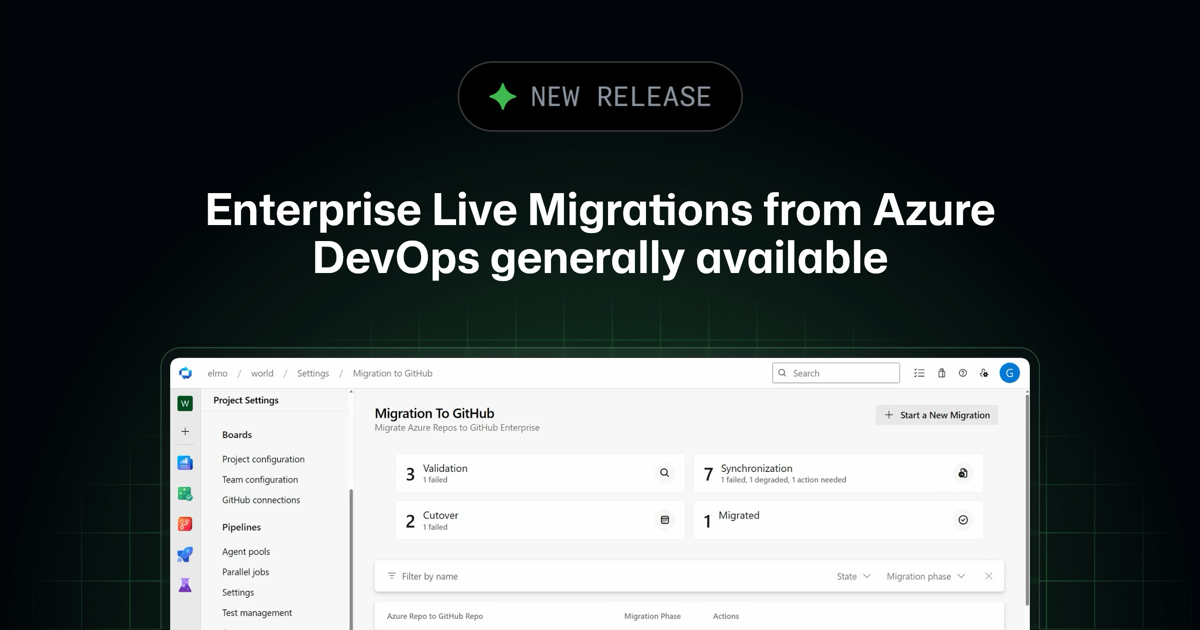
GitHub has made Enterprise Live Migrations (ELM) from Azure DevOps Services to GitHub Enterprise Cloud generally available. The new capability lets organizations shift their code repositories, history, and related work items to GitHub while development continues uninterrupted, and then complete the cut‑over at a time that suits their teams.
What's new
- Live migration support – ELM continuously syncs changes from Azure DevOps to GitHub, so developers can keep contributing during the migration.
- Portal or CLI management – Choose a guided migration experience in the Azure DevOps portal or script the process with the Azure DevOps CLI.
- Pre‑migration validation – Built‑in checks identify potential issues before the cut‑over, helping teams plan a smooth transition.
- Full history transfer – Git history, branches, tags, pull requests (including titles, descriptions, comments, and user activity) are migrated. Azure DevOps branch policies become GitHub branch rule sets.
- Azure Boards and Pipelines integration – ELM can automatically create the Azure Boards connection and rewire Azure Pipelines to the new GitHub repository, preserving work items and pipeline definitions.
- Data residency compliance – Migrations move data to GitHub Enterprise Cloud locations that meet organizational residency requirements.
Why it matters
For enterprises that have built their development workflows around Azure DevOps, moving to GitHub can bring advantages such as a broader ecosystem of integrations, a larger developer community, and unified collaboration tools. However, migration has traditionally required downtime or extensive manual effort, creating risk and disruption.
ELM addresses these concerns by providing a continuous sync model. Teams can keep pushing code, opening pull requests, and updating work items while the migration runs in the background. The ability to validate the migration ahead of time reduces the chance of unexpected failures at cut‑over.
Preserving the full Git history and pull‑request metadata ensures that audit trails and knowledge bases remain intact, which is critical for compliance and for onboarding new team members. Migrating branch policies as GitHub rule sets helps maintain security and quality gates without rebuilding them from scratch.
The automatic handling of Azure Boards and Azure Pipelines connections further lowers the operational overhead after migration. Organizations can continue to use familiar planning and CI/CD tools while benefiting from GitHub’s repository features.
Overall, the generally available status of Enterprise Live Migrations signals that GitHub and Microsoft have matured the integration to a production‑ready level, making large‑scale, low‑risk migrations a realistic option for enterprises.
Ready to start your migration journey? Visit Microsoft’s ELM documentation to learn more and get started.